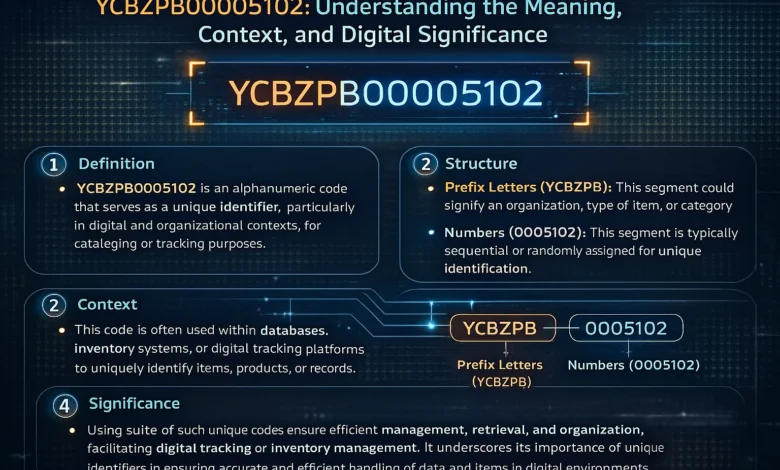
In the modern digital landscape, unusual alphanumeric strings often capture attention because they seem mysterious, technical, or hidden in purpose. One such keyword is ycbzpb00005102, a term that does not immediately reveal its meaning yet holds relevance in discussions around identification systems, coded references, and structured data environments. This article explores ycbzpb00005102 in depth, examining its possible context, conceptual significance, and the broader digital frameworks in which such identifiers commonly appear, while maintaining a clear and informative perspective for readers seeking clarity.


The Nature of Alphanumeric Identifiers Like YCBZPB00005102
Alphanumeric identifiers such as ycbzpb00005102 are widely used in digital systems to create unique references that distinguish one record, object, or process from another. Unlike simple names or labels, these identifiers are designed to avoid duplication and confusion, especially in environments that manage large volumes of data. The structure of ycbzpb00005102 suggests intentional formatting, combining letters and numbers to increase uniqueness and improve system-level organization. Such identifiers are rarely random; instead, they often follow internal rules that define how data is generated, stored, and retrieved.
In many systems, identifiers like ycbzpb00005102 act as silent anchors behind the scenes. Users may never see them directly, yet they play a critical role in ensuring that information remains consistent across databases, applications, and platforms. This makes them essential to digital reliability, even if their meaning is not immediately apparent to the average user.
Possible Contexts Where YCBZPB00005102 May Appear
The keyword ycbzpb00005102 can theoretically appear in several digital or technical contexts. In software development, such strings are commonly used as internal reference codes tied to specific entries, configurations, or events. In data management environments, they may represent transaction identifiers, record numbers, or internal tracking values that help systems maintain accuracy and traceability over time.
Beyond software, identifiers similar to ycbzpb00005102 are often used in logistics, digital archiving, research databases, and automated workflows. Their purpose remains consistent across fields: to ensure that each element within a system can be individually recognized without ambiguity. Even when users do not understand the code itself, the system relies on it to function smoothly and efficiently.
Structural Analysis of YCBZPB00005102
Examining the structure of ycbzpb00005102 reveals a deliberate combination of letters followed by a sequence of numbers. This format is commonly used to separate categorical information from sequential or numerical data. The alphabetic portion may hint at a system type, department, or classification, while the numeric segment often indicates order, version, or uniqueness within that category.
This type of structure allows systems to scale effectively. As more entries are created, the numerical portion can increase while the alphabetic prefix maintains contextual grouping. In this way, ycbzpb00005102 fits a pattern that prioritizes both organization and flexibility, two essential qualities in modern data systems.
The Role of Unique Codes in Data Integrity
Data integrity is one of the most critical concerns in any digital environment, and identifiers like ycbzpb00005102 play a central role in preserving it. By assigning a unique code to each data element, systems reduce the risk of duplication, accidental overwrites, or misattribution. This is particularly important in environments where thousands or even millions of records are processed automatically.
When a system references ycbzpb00005102, it is pointing to one specific entity and nothing else. This precision allows for accurate updates, secure transactions, and reliable reporting. Without such identifiers, complex systems would struggle to maintain order, especially as they grow in size and complexity.
YCBZPB00005102 in the Context of Automation
Automation relies heavily on consistency and predictability, both of which are supported by structured identifiers. A code like ycbzpb00005102 can be read and processed by machines far more efficiently than descriptive text. This makes it ideal for automated workflows where speed and accuracy are essential.
In automated systems, ycbzpb00005102 might trigger a specific action, reference a stored configuration, or link multiple processes together. While humans may see it as a simple string, machines interpret it as a precise instruction or reference point. This highlights the invisible yet powerful role that such identifiers play in the background of everyday digital interactions.
Human Perception Versus System Logic
From a human perspective, ycbzpb00005102 may seem abstract or meaningless at first glance. People naturally seek recognizable words or patterns, and alphanumeric strings can feel impersonal or confusing. However, from a system logic standpoint, this lack of inherent meaning is actually a strength. It prevents subjective interpretation and ensures that the identifier remains stable and unchanging regardless of context.
This contrast between human perception and system logic is a defining feature of modern technology. Identifiers like ycbzpb00005102 are not designed to be memorable or expressive; they are designed to be precise. Understanding this distinction helps users appreciate why such codes exist and why they are so widely used across digital infrastructures.
Security and Traceability Considerations
Security is another area where identifiers such as ycbzpb00005102 become especially important. Unique codes enable systems to track actions, changes, and access patterns over time. When an event is logged with a specific identifier, it becomes easier to audit activity and identify irregularities if they occur.
Traceability also benefits from consistent identifiers. If an issue arises, systems can trace it back through logs and records associated with a specific code like ycbzpb00005102. This capability supports accountability and transparency, particularly in environments that require detailed monitoring and reporting.
The Evolution of Coded Identifiers
The use of coded identifiers has evolved alongside technology itself. Early systems relied on simple numbering schemes, but as data volumes increased, more complex formats became necessary. Alphanumeric combinations like ycbzpb00005102 reflect this evolution, offering a larger pool of unique values and more flexible structuring options.
As digital ecosystems continue to grow, the importance of well-designed identifiers will only increase. They form the backbone of interconnected systems, enabling communication between components that may never directly interact with users. In this sense, ycbzpb00005102 represents not just a single code, but a broader design philosophy centered on scalability and reliability.
Interpreting YCBZPB00005102 Without Assumptions
One important aspect of dealing with identifiers like ycbzpb00005102 is resisting the urge to assign meaning where none is intended. While it can be tempting to decode or interpret each segment, many systems generate identifiers purely for uniqueness rather than semantic value. Understanding this helps prevent misinterpretation and ensures that users interact with systems as intended.
By treating ycbzpb00005102 as a functional reference rather than a descriptive label, users and developers alike can focus on its role within the system rather than speculating about its origins. This practical mindset supports clearer communication and more efficient problem-solving.
Broader Implications of Identifier-Based Systems
The widespread use of identifiers such as ycbzpb00005102 reflects a broader trend toward abstraction in digital design. Rather than relying on human-readable labels, systems increasingly depend on structured codes that prioritize efficiency and accuracy. This approach allows technology to scale beyond the limits of manual management and into realms where automation and artificial intelligence can operate effectively.
In this context, ycbzpb00005102 becomes a small but meaningful example of how modern systems think and operate. It symbolizes the shift toward data-driven structures where clarity for machines is often more important than immediate readability for humans.
Conclusion: Why YCBZPB00005102 Matters
Although ycbzpb00005102 may appear insignificant at first glance, it represents a fundamental concept in modern digital systems. As a structured identifier, it supports organization, automation, security, and scalability across a wide range of applications. Its value lies not in what it says, but in what it enables behind the scenes.
Understanding the role of identifiers like ycbzpb00005102 helps demystify the invisible mechanisms that power today’s technology. By appreciating their purpose and function, users gain insight into how complex systems maintain order and reliability in an increasingly digital world.